


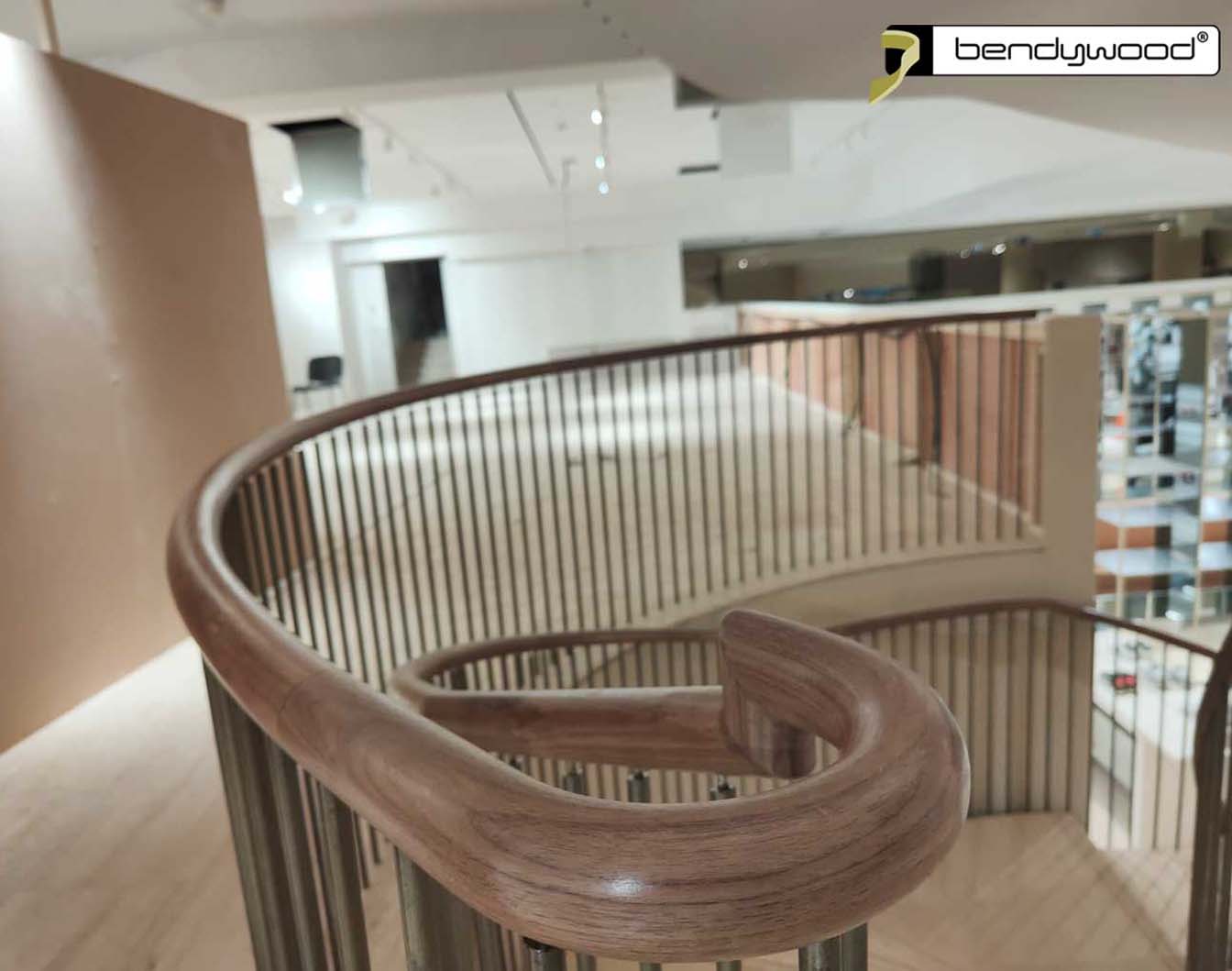
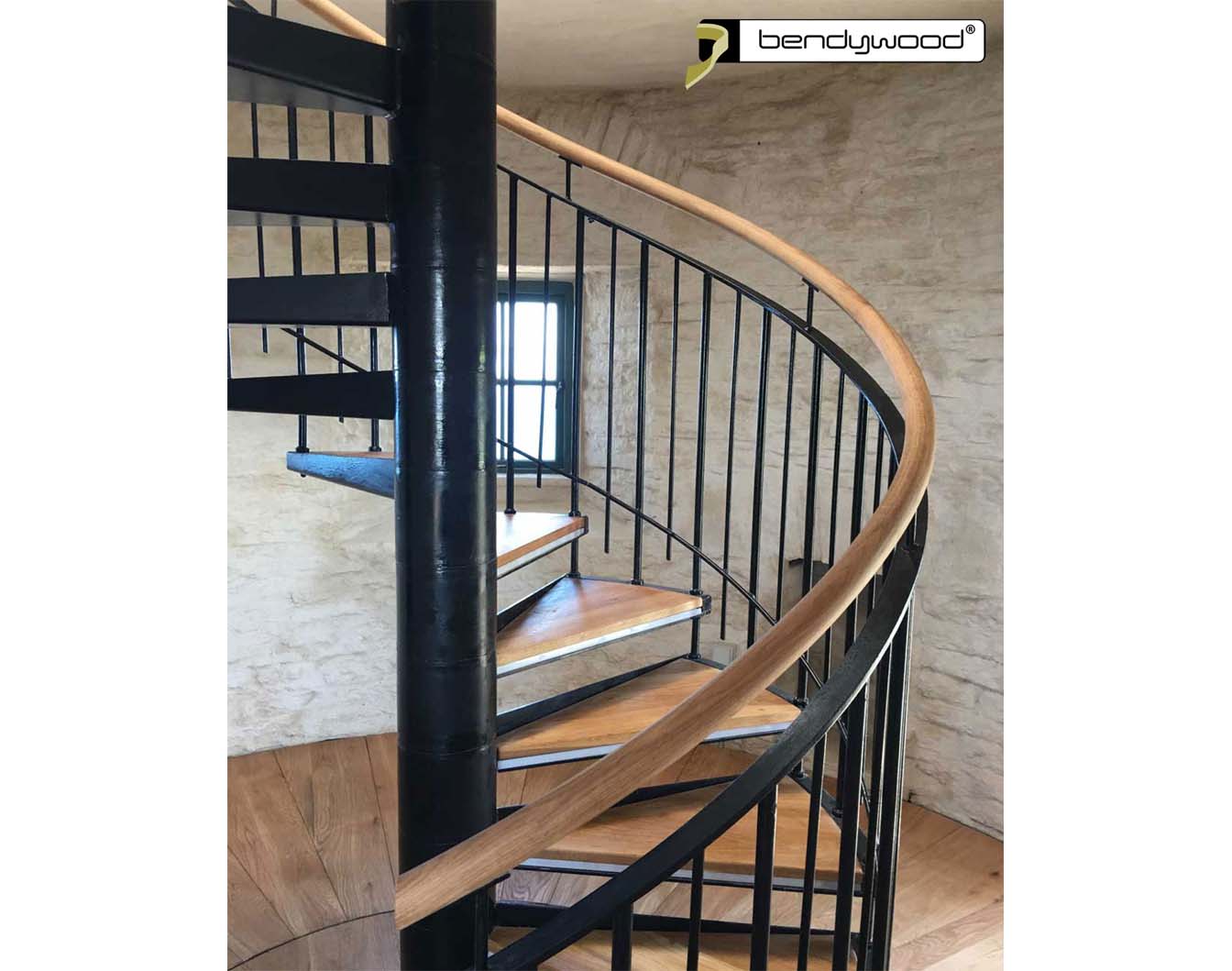
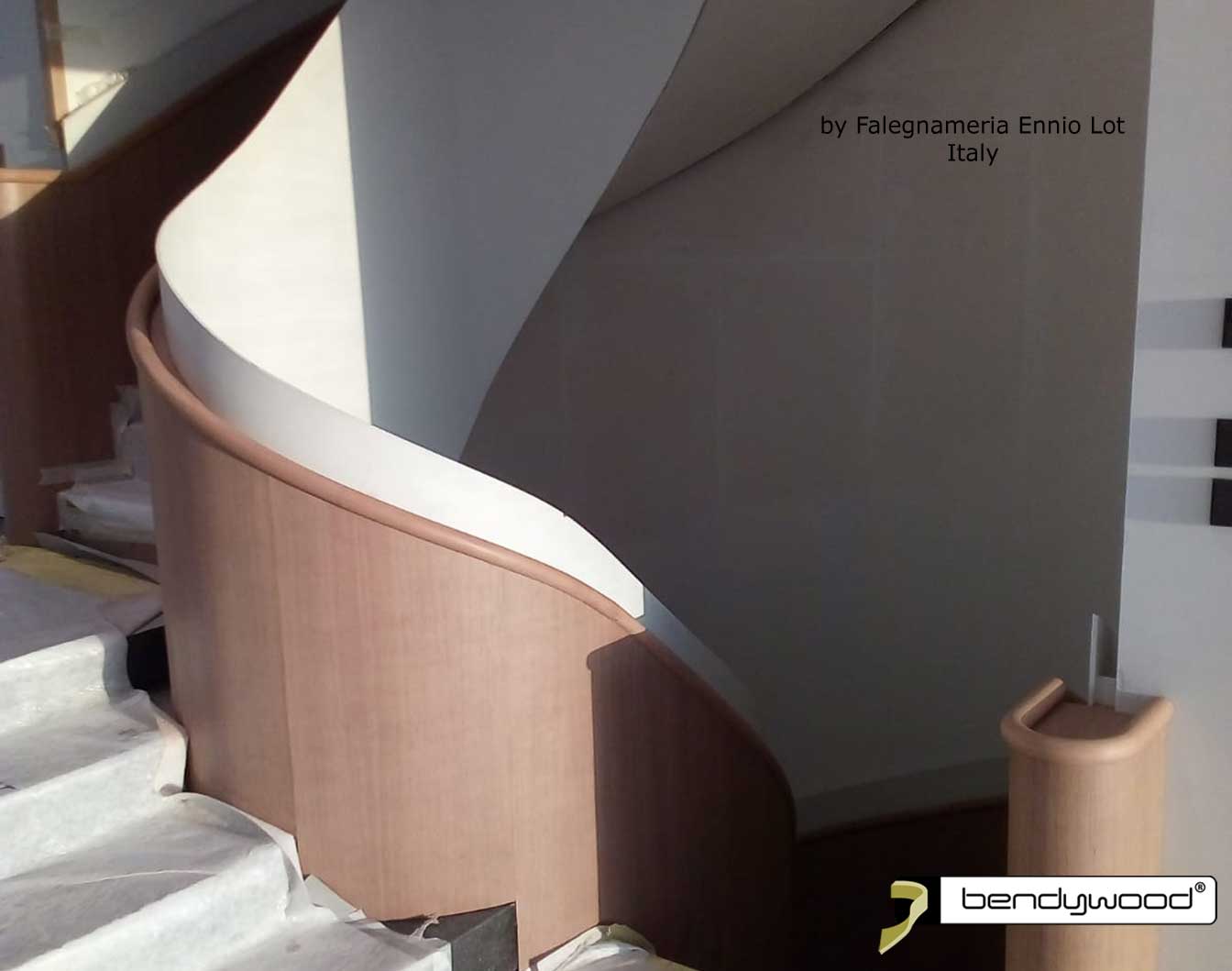
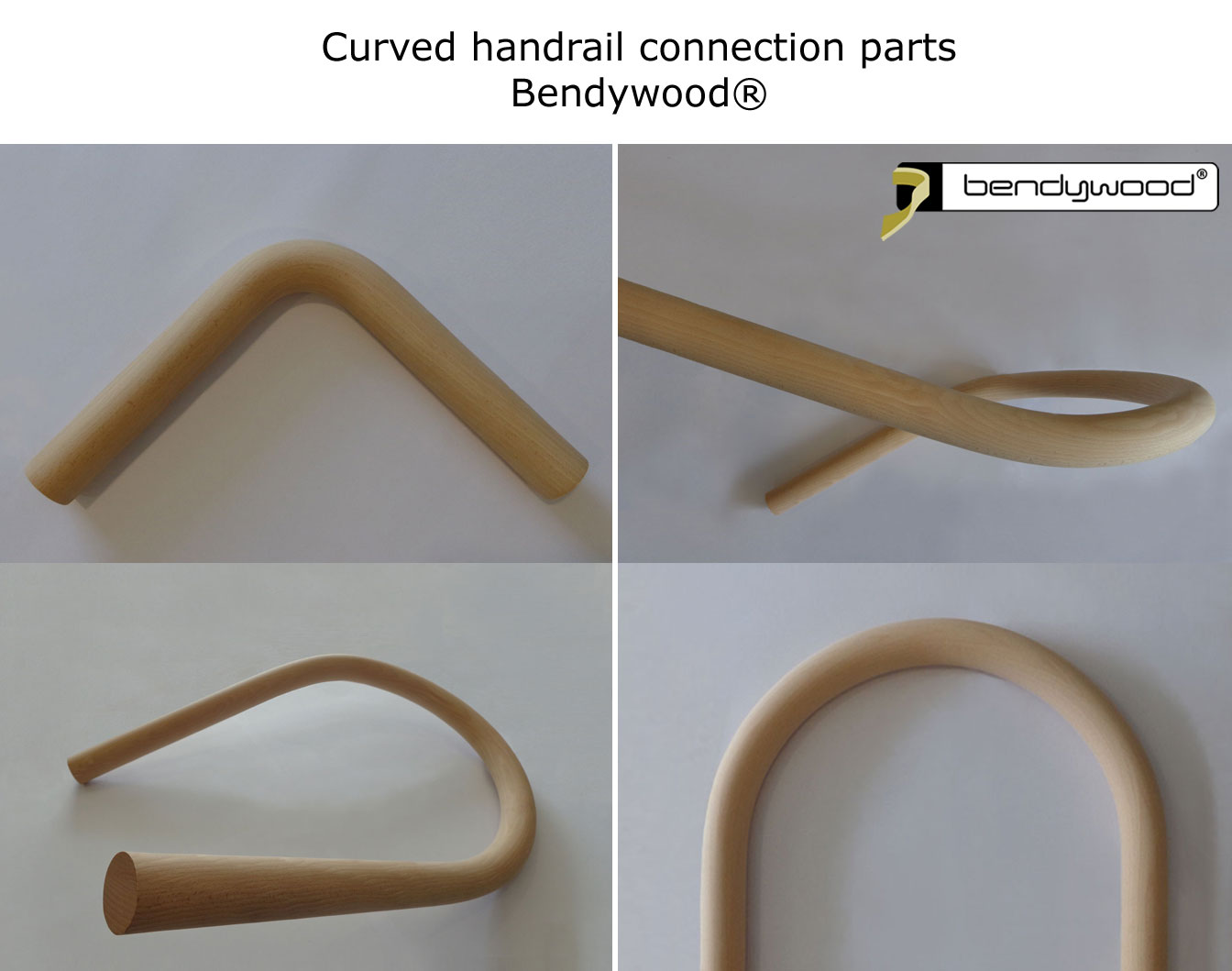


Do not bend Bendywood® handrails directly on the railing!
Pre-bend the handrails on a template and over-bend them by approximately 30%!You can find the instructions at the following link:
How are handrails bent against a template?
Bendywood® handrails can be bent up to a radius of 20 times the profile's cross section. A 40 mm round profile up to a radius of 800 mm, for instance, and a 50 mm profile up to a radius of 1.000 mm.In order to be able to bend up to these limits a wood moisture content of about 12% is indispensable.
See part 2. How to bend and moisten Bendywood®.
Bendywood® handrails are delivered with a wood moisture level of approx. 12%.
Handrails must not be bent immediately: packaged wooden moisture last for a good 2 months.
The handrails should only be unpacked just before you start bending.
ATTENTION:
The pre-bent handrails open up when removed from the template: they have been "over-bent,"
that is, bent with smaller bending radii to compensate for this opening.
See the following link: “Spring-back after being taken from the mould”.
The available Bendywood® handrails are shown in the catalog, see under: Catalogue
The pliable handrails are:
- made of solid hardwood
- pre-profiled, roughly sanded
- with 12% wood moisture, ready for bending
BENDING JUST BY HAND:
a. Bending an ascending handrail around a flat mould:
this is the easiest and best solution for spiral staircases!
The handrails with normal joints  are also well suited for this
See video for a round handrail:
See video for a round handrail with flat bottom side:
PARTICULARLY IMPORTANT:
1. Always bend around a mould - as shown in the videos
2. Position the matching bend mould / chunks for pressing exactly opposite to the joint

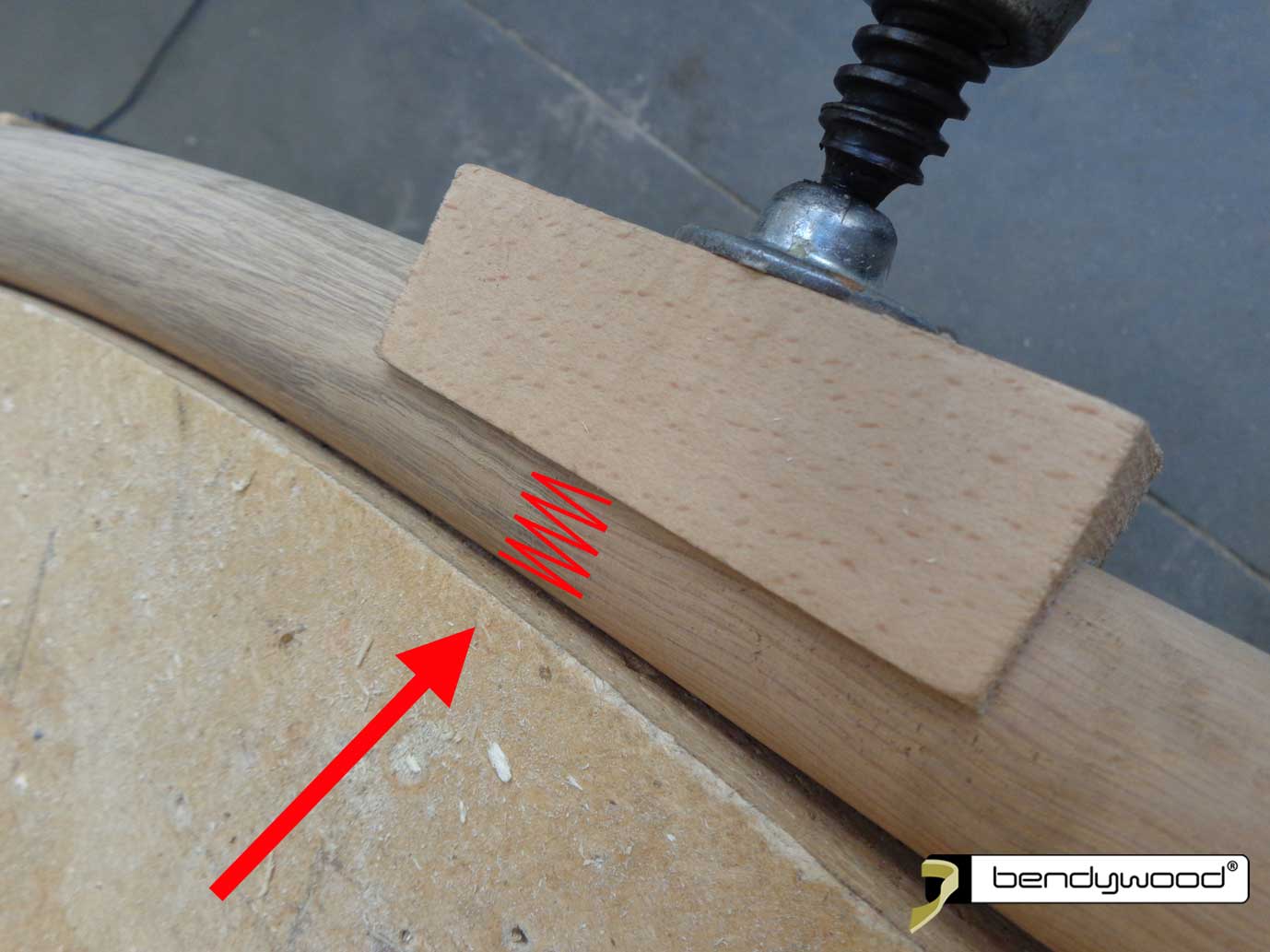
3. Ascending handrails should be pre-bent around a flat mould. Only after approx. 24 hours the 3D bending can be carried out at the banister.
The following video shows how such a handrail is installed upwards:
The flat pre-bending has the following advantages:
- The transport costs are significantly lower than the costs for shipping long straight sections.
- It is possible to perform the upwards bending later, when mounting the bending handrail.
- It is also possible to combine normal wood with Bendywood®.
- Also lengths up to 12 m are feasible, as special production.
- Handrails with groove/plow are also possible.
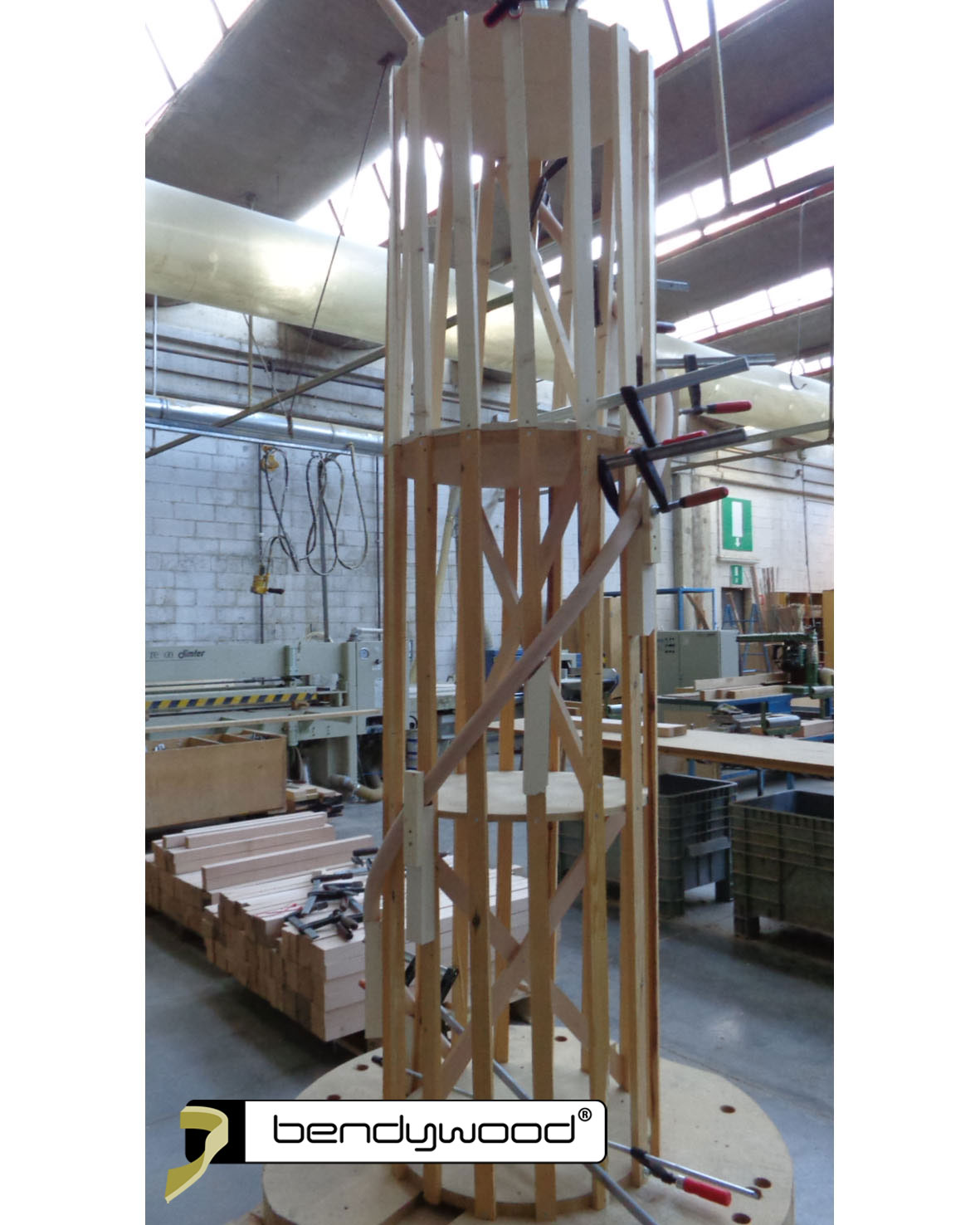
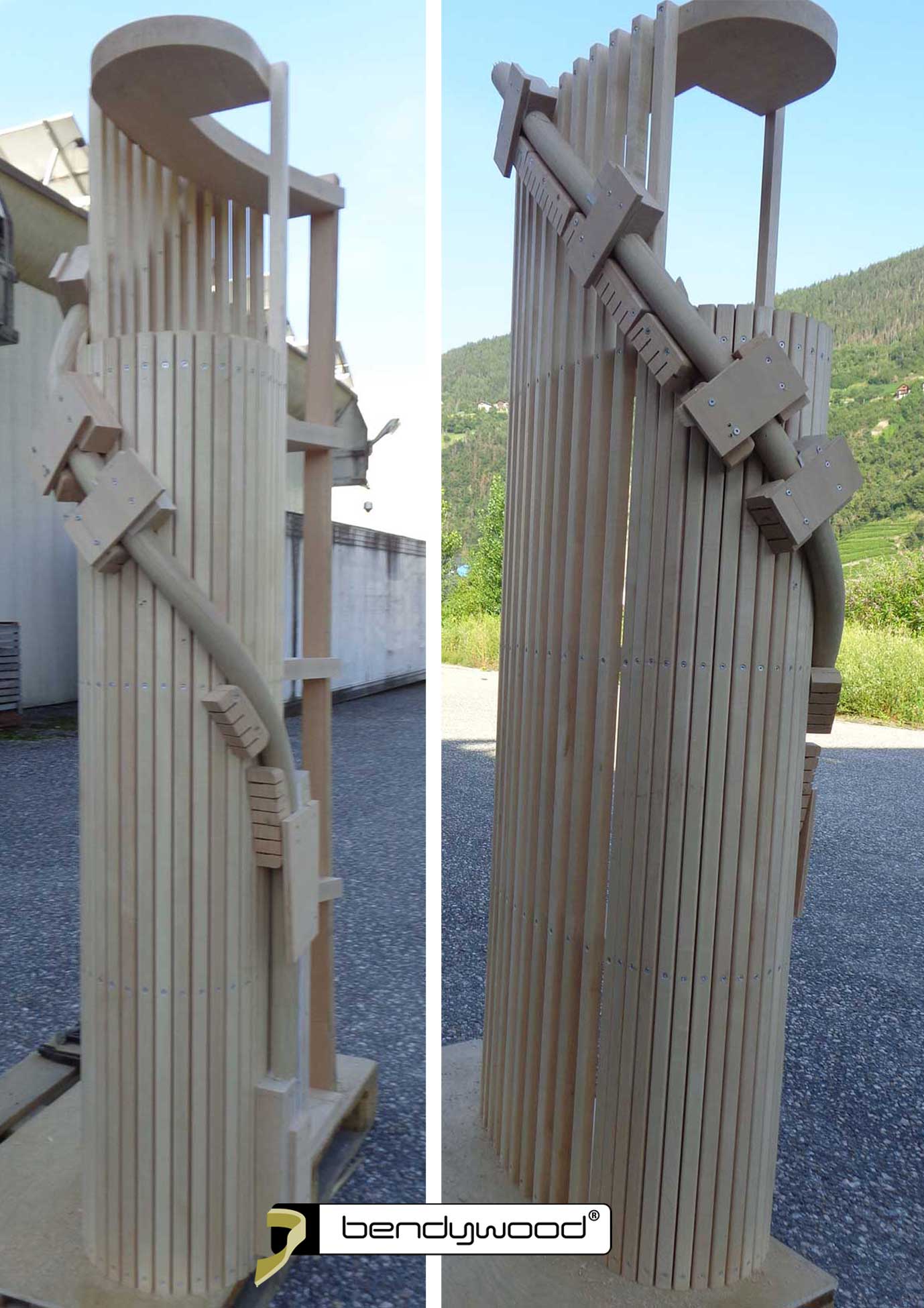
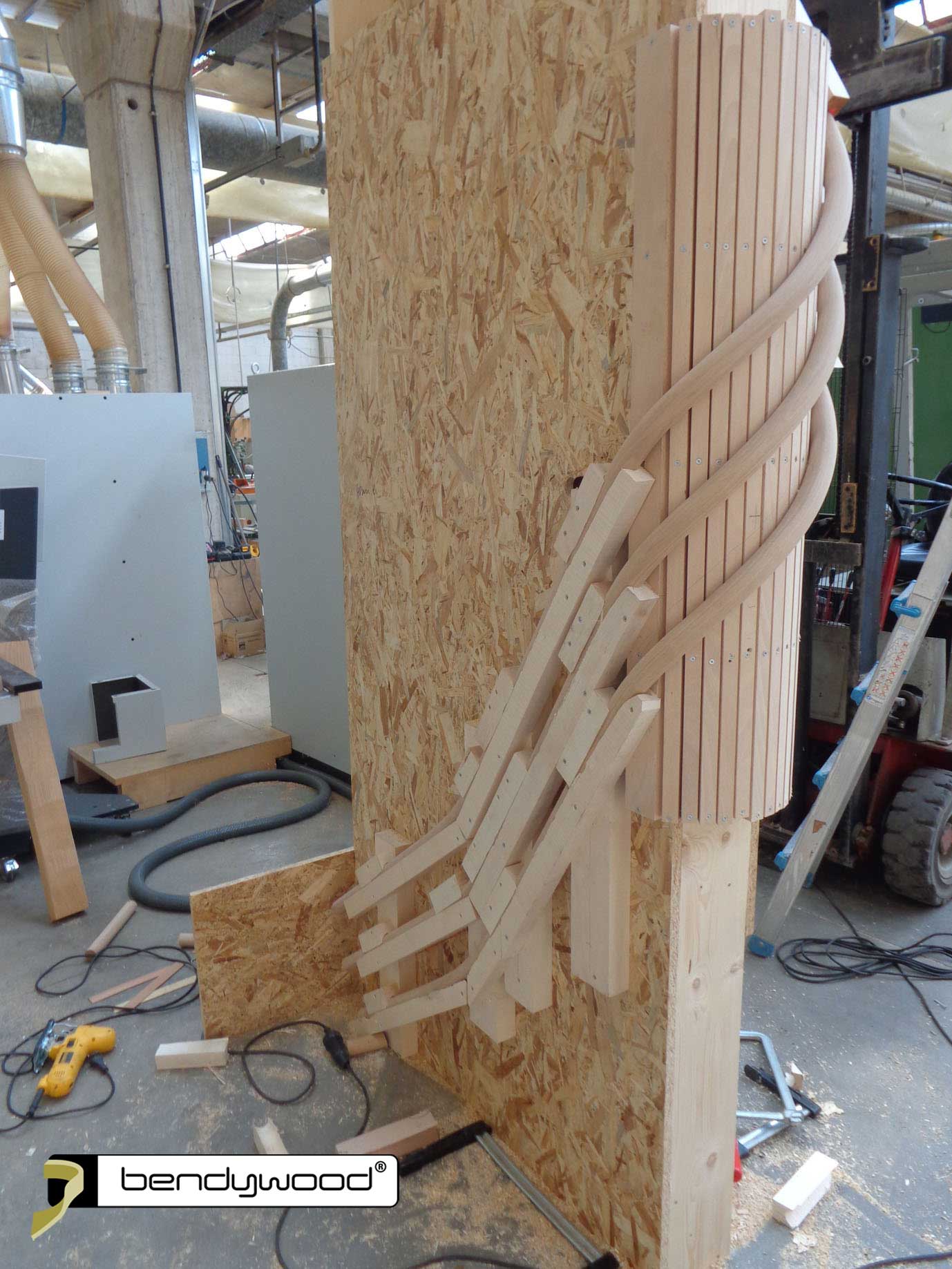
b. Bending an ascending handrail around an ascending mould / assembly support:
When flat pre-bending is not possible, for example with steeply rising handrails and when 3D pre-bending
is required, special templates are needed for this purpose.
You can find illustrations of these at: Bending moulds for Bendywood®


BENDING BY USING A RING ROLLING BENDING MACHINE:
- Solely the bending handrails with diagonal joints
 can be pre-bent with a ring rolling bending machine (up to a radius of 1 : 30), as only diagonal joints can endure the mechanical stress of a bending machine. A handrail with a diameter of 40 mm, for instance, can be bent up to a radius of 1.200 mm. The final bending - if necessary - up to a radius of 1 : 20 should be carried out by hand around a mould or on the banister. See the following video to this:
- Tighten the bending radius progressively, letting the handrail run through the rollers of the bending machine not more than 3 times. Bear in mind that the ring rolling bending machine also rolls the wood and rolled Bendywood® will reach its limit of flexibility more quickly. Consequently, a 40 mm thick handrail, for instance, can only be bent up to a radius of 1.200 mm by machine, then you should continue by hand.
- The bending handrails with normal joints CANNOT be bent with a ring rolling bending machine.
HOW TO BEND NON-ROUND HANDRAILS UPWARDS ?
All handrails turn on their own axis when being bent upwards. This torsion is not visible in case of a round handrail, as a round profile always looks the same when turned. In case of other profiles or round profiles with a groove/plow it is necessary to compensate for torsion, so that the lower part of the handrail remains below.
It is best to proceed as follows: (in one operation cycle)
First of all bend the handrail on a flat mould. Then clamp it onto the banister (which ideally has a flat steel strip or similar) starting from above. The "turning" should be carried out using a long-arm clamp, which needs to be clamped onto the handrail at a distance of 1,5 m in order to have sufficient leverage.
FORMULA FOR CALCULATING THE LENGTH OF A SPIRAL STAIRCASE HANDRAIL:



EXAMPLE:
Assuming:
- 18 steps
- Step rise: 17 cm
- Step run beneath inner handrail: 13 cm
- Step run beneath outer handrail: 40 cm
